Here is a comprehensive on-line calendar put together by the Music Technology Group (MTG) of the Pompeu Fabra University (UPF) of Barcelona. I'll also enter it into the Links section on the main page for easy referral.
(Hat tip: Adv Projects in Computer Music)
Monday, February 06, 2006


Powerful sound waves
This has been reported all over the Internet but, for the sake of completeness, I'll link to the PhysOrg article on sonofusion here.
A team of researchers from Rensselaer Polytechnic Institute, Purdue University, and the Russian Academy of Sciences has used sound waves to induce nuclear fusion without the need for an external neutron source, according to a paper in the Jan. 27 issue of Physical Review Letters.
You Don't Know Jack About VOIP
The title of the article on ACM Que says it all. Good overview of Voice Over IP.
Saturday, February 04, 2006
Improving forensic capabilities in other countries
The United States and EU governments frequently help develop the forensics capabilities of law enforcement agencies in other countries (Note: other governments elsewhere may also have similar training and grant programs, but I am drawing only upon my own direct knowledge here).
If you are interested in the international cooperation aspects of law enforcement or want to read a very descriptive article about life in a forensics lab, I can recommend a post found on INDONESIA NOW. I'll excerpt a portion of it here:
If you are interested in the international cooperation aspects of law enforcement or want to read a very descriptive article about life in a forensics lab, I can recommend a post found on INDONESIA NOW. I'll excerpt a portion of it here:
Forensics aren’t at the sharp end of police duties. Most who chose a career in crime-fighting prefer the adrenalin rush of a high-speed chase, a shoot out, a dash in the dark to nab a felon.To read.
Laboratory work is quiet and methodical; it’s cerebral, not muscular. It means wearing rubber gloves rather than a holster, peering down microscopes, analysing chemicals, thinking deeply and cleverly to outsmart the cunning crims. It’s often boring and lonely.
But when the results gain convictions even the most heavy-fisted cop from the school of hard knocks has to pause in admiration for his tertiary-trained colleagues.
The Surabaya lab investigates cases from across East Java and much of Kalimantan, a catchment area of more than 42 million people. To handle this workload Bambang has only 40 scientists and technicians, and just a few machines.
But help is on its way. Eighteen months ago experts from the US Department of Justice visited Surabaya and reported on the lab.
They found that while Bambang was respected and his colleagues had depth of experience, knowledge and skill, much equipment was outdated.
This year the lab expects high tech replacements under a program called the International Criminal Investigative Training Assistance Program. (ICITAP)
How to support this site
If you like this site, here are some things you can do to support it:
- Spread the word around - Talk about this site to friends, acquaintances and anyone else who is even remotely interested in audio, video, or forensics.
- Post a comment - You are welcome to post a comment telling your views about the topic I write about. You can tell me what you like or dislike about my post, any mistakes I have made (all humans are prone to mistakes and I will try to correct mine) and any new things you know about the topic.
- Suggest new topics - If there is a new topic you would like to see written about or an old topic you would like to see more of, just let me know by sending an email (see the Links section on the right-hand side of the main page and don't forget to remove the anti-spam characters from my email address).
- Link to it - if you have a blog or other site, feel free to link to posts here. I only ask that you follow the commonly accepted rules of behavior (and for that matter, legalities) concerning blogging, copyrights, and the like.
CSI, a clay pot, forensics and ancient audio histories
 It is truly amazing what you can do with forensic science these days. I came across this entry in Wikipedia having to do with the popular TV forensic drama "CSI: Crime Scene Investigation":
A clay pot in the episode "Committed". Crafted while two people were having an argument. Of course, the marks on the pot were vibrating to the argument. When the clay pot is analysed, they shoot a laser at it and get a sound back. Behold! It's the argument being played back - reproduced from the bumps and grooves made in the pot during the argument.Now, assuming this is accurate (and I did google it to see if other websites had the same info and found other references to it that didn't look like copies of the Wikipedia entries), this could lead to all kinds of fascinating discoveries. Imagine being able to listen to what the slaves and artisans in ancient times were saying around their drying clay pots, bricks, and ovens! Now that old line that goes something like 'the stories these walls could tell' can finally come true!
Of course, forensic filtering will probably have to be applied to reduce the effects of centuries of accumulated dust, grime, and cracks. Hmmm... That probably means hiss, muffling, and pops & clicks, as a minimum, but we've got filters for those - no problem!
If you need me, I'll be down at my local museum (after picking up a laser and an ancient languages scholar from the university on the way)...
(Image source: News in Science article on restoring ancient clay pots - also interesting reading)
Blue light makes people alert at night
 Live Science has a write-up on a study by Steven Lockley of the Brigham and Women's Hospital and Harvard Medical School that indicates that blue light makes people less drowsy in the middle of the night. The affect also was found to be long lasting - the study tested out to 6.5 hours without identifying the end of it. The research is reported in the February 1 issue of the journal Sleep.
Thursday, February 02, 2006
Handwriting Analysis
This is slightly off-topic, but I hope still acceptable as it is regarding forensics.
The January 26th online edition of the Boston Globe has an interesting piece on a modern-day handwriting analyst ('Handwriting analyst has eye for reading between the words'). Handwriting analysis (i.e. graphology) is the study of handwriting and how it relates to character (source: The Free Dictionary).
Graphology is currently frowned on by the forensic community in general. The article mentions that an attempt is underway to get it accredited, however.
I'm not trying to lend credence to this field by mentioning it here. That being said, I did find the article interesting and intend to monitor the progress of the accreditation attempt.
To Read.
(Hat tip: Forensic Files)
What's Next - Cameras
The online edition of the International Herald Tribune on February 2nd has an article about the upcoming annual Photo Marketing Association convention and where the camera market is going next (For cameras, it's a digital world) . The highlights are:
To Read
- The market for film cameras is (almost) dead - 92% of all cameras sold now are digital.
- Digital cameras are evolving away from looking like film cameras.
- Multiple lenses - dual built-in zoom and wide-angle lenses are available.
- The end of the megapixel race - similar to what happened in the PC market, most people have enough pixels to do what they need.
- Wireless - some models will lose their cables in favor of wireless downloads/uploads.
- Image stabilization - "steady shot" comes to still cameras to eliminate problems with shaky hands, high zoom ratios, and holding the camera away from the body, all of which cause jittery images.
- Video/still combos - already available but coming even more common to have video capable 'still' cameras.
- Bigger, faster, better - larger image sizes and faster video frame rates on some makes/models.
- GPS - automatically tag each image with location (along with traditionally time/date).
- "Blink Shot" - recognize when subject's eyes are closed and prevent the picture from being taken.
To Read
Sunday, January 29, 2006
IBM Speech Technology Roundup
PC Magazine has an article on speech recognition technology research at IBM. The article starts off reporting on the release of Embedded ViaVoice 4.4 and then goes on to talk about the various bits of speech research going on across IBM - and there is quite a lot.
After the hype of a few years ago quieted down, speech recognition technology has been progressing slowly but steadily with implementations being fielded, tinkered with, and re-tried until useful applications emerged in the darwinian world of day-to-day business. Just try making an airline reservation over the phone or calling a major credit/charge card company and you will see what I mean.
Some pretty impressive achievements are claimed in the article about not only speech recognition but language translation. English-Chinese translation is being addressed by a project called MASTOR (Multilingual Automatic Speech-to-Speech Translator) while on-the-fly translation of Arabic television to create English subtitles is tackled by project Tales. Tales is said to achieve an accuracy rate of between 60 and 70 percent with a four minute lag time (for processing) and 80 percent with a longer one. In an article like this, one usually doesn't get enough details to satisfy one's technical curiosity - such as how is 'accuracy' defined and exactly what conditions it achieved those results - but even if these numbers are a little too optimistic, it is still more than good enough to 'gist' Arabic in almost in real-time.
Saturday, January 28, 2006
Video Compression and Enhancement
I recently had two posts, one about compression of CCTV archives and the other about image stabilization. These two posts actually have something in common. In case while reading the one about CCTV you thought "If the image is not clear, then they can just filter it", you should understand that it won't work very well.
The reason is that filtering compressed images generally causes the compression artifacts (little 'errors' left behind after removing the image detail) to get amplified, thereby making the filtered image worse than the original compressed one. My attempts (on real-life video, not simulated images) have shown that image stabilization, brightness and contrast are about the only filters that can reliably work on (lossy) compressed video. Edge contrast enhancement and other such techniques that work very well on uncompressed images do not work on compressed ones (at least none of the ones I've seen so far).
The reason is that filtering compressed images generally causes the compression artifacts (little 'errors' left behind after removing the image detail) to get amplified, thereby making the filtered image worse than the original compressed one. My attempts (on real-life video, not simulated images) have shown that image stabilization, brightness and contrast are about the only filters that can reliably work on (lossy) compressed video. Edge contrast enhancement and other such techniques that work very well on uncompressed images do not work on compressed ones (at least none of the ones I've seen so far).
Tuesday, January 24, 2006
Reconstucted Native American Language
 MSNBC has an interesting article about the reconstruction of a Native American language for the upcoming movie about Pocahontas and Captain John Smith called "The New World". A linguist at UNC-Charlotte, named Blair Rudes, resurrected the language from a couple of surviving writings and knowledge of other related, but better documented, Algonquian languages.
You may have to scroll down to find the article...
Image: New Line Cinema
(Hat-tip: SciTech Daily)
Thursday, January 19, 2006
Motion Blindness
Now here is a medical case that illustrates just how 'strange' the human visual system is:
Pretty cool stuff. I recommend reading the whole article. By the way, the site also has several more interesting pages on sight and hearing.
I came across this on the Howard Hughes Medical Institute site. The article goes on to talk about how the visual systems of other species are different. For instance, humans detect motion with their brains while simple vertibrates, such as frogs, do it with their retinas instead (I didn't know that).The patient had great difficulty pouring coffee into a cup. She could clearly see the cup's shape, color, and position on the table, she told her doctor. She was able to pour the coffee from the pot.
But the column of fluid flowing from the spout appeared frozen, like a waterfall turned to ice. She could not see its motion. So the coffee would rise in the cup and spill over the sides.
More dangerous problems arose when she went outdoors. She could not cross a street, for instance, because the motion of cars was invisible to her: a car was up the street and then upon her, without ever seeming to occupy the intervening space.
Even people milling through a room made her feel very uneasy, she complained to Josef Zihl, a neuropsychologist who saw her at the Max Planck Institute for Psychiatry in Munich, Germany, in 1980, because "the people were suddenly here or there but I did not see them moving."
The woman's rare motion blindness resulted from a stroke that damaged selected areas of her brain.
Pretty cool stuff. I recommend reading the whole article. By the way, the site also has several more interesting pages on sight and hearing.
New RCFL opened to serve Rocky Mountain region in USA
 A new Regional Computer Forensics Laboratory (RCFL) has been opened in Denver, Colorado (USA). The new lab, unsurprisingly christened the Rocky Mountain RCFL, will provide federal, state, and local law enforcement organizations throughout the states of Colorado and Wyoming with digital evidence examination services. The RCFLs are regional collaborations of law enforcement agencies that provide the personnel and local management for the labs. The Operational Technology Division (OTD) of the US Federal Bureau of Investigation (FBI) provides equipment, training, technical, procedural, and financial support to the laboratories. By the end of the year, a total of 14 RCFL facilities are expected to be up and operating.
The RCFL concept is a bit of a departure from the old model of separate forensic labs at the federal, state, and local levels, with the tougher cases being sent up the chain when lower level skill and/or resources were exceeded. The RCFL concept places additional equipment, training, and expertise out in the regions to handle things more locally. Of course, the central federal labs are still there to provide national level skills and resources when needed.
I've had the opportunity to meet and train RCFL personnel and have been positively impressed with the ones I've met thus far. Although it will take some years for the new labs to grow into themselves, so to speak, the collaborative regional concept holds the potential of significant benefits from local leadership, as well as the distribution of workload to the appropriate levels of the nation's laboratory 'network'.
Image: Photo from the Rocky Mountain RCFL Opening (L-R RMRCFL Director, C.Buechner, FBI OTD Assistant Director K.Haynes)
(Hat tip: Nieuwsbank)
Tuesday, January 17, 2006
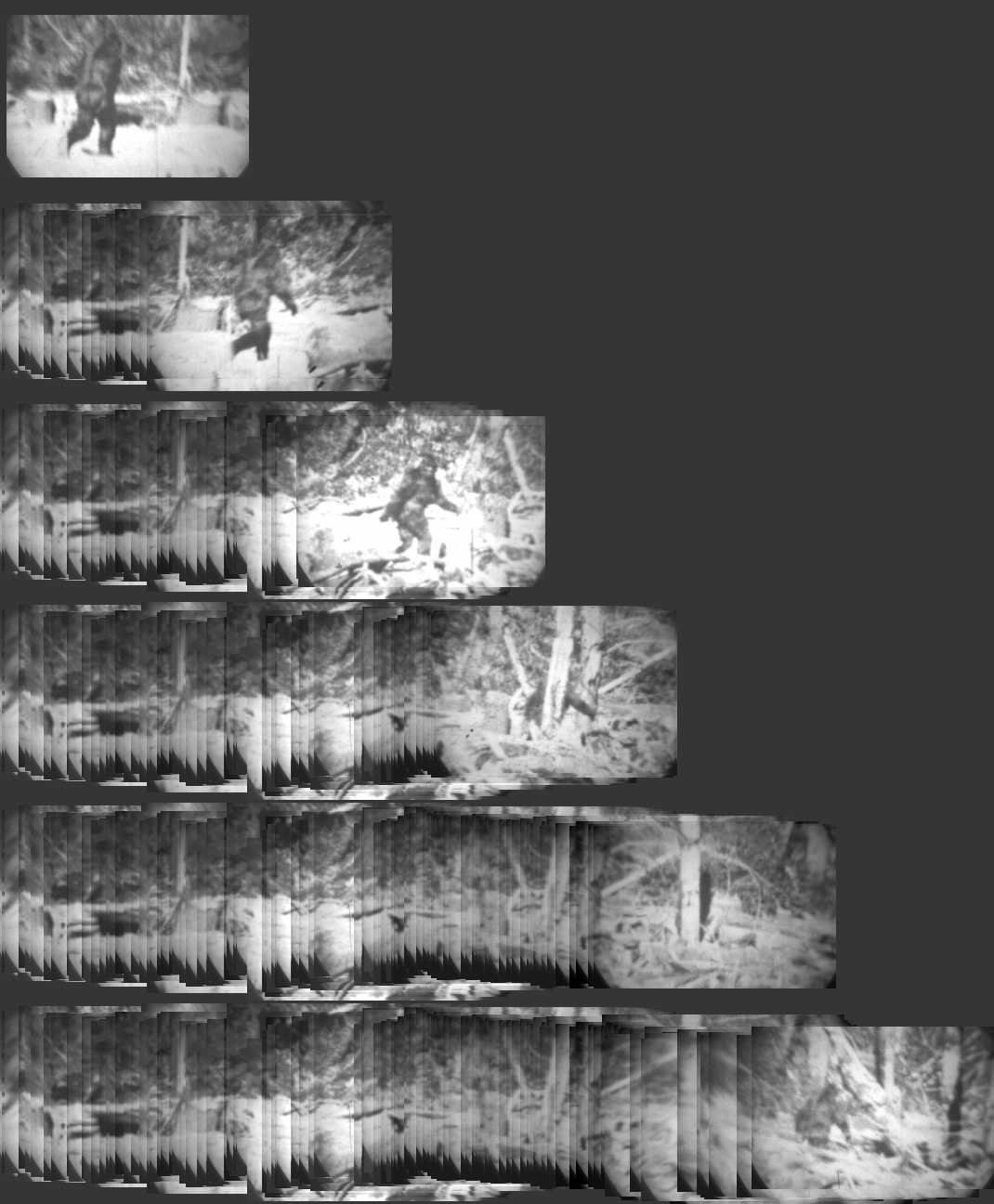
Stabilization of Bigfoot "encounter" video
 Fun link for the day: An animated GIF of a classic Bigfoot video that has been stabilized.
Over the years, I've had a hand in developing automatic video stabilization filters. Simply put, what these filters do is automatically recognize the motion of the subject in the video, then correct (i.e. re-register) each field by moving the field image up/down/sideways to make the subject line up in the same position as in the previous field, then go to the next field and repeat.
What has been done in this Bigfoot GIF is to combine stabilization with video mosaicking (i.e. making a bigger picture out of a collection of video frames). This is a powerful technique to use on aerial video of the ground or, for that matter, Bigfoot sightings... So, do you think it is just a guy in a suit or not?
(Hat tip: Digg)
Subscribe to:
Posts (Atom)