Tuesday, May 30, 2006

Commercial loudspeaker array

I recently blogged about microphone array support coming to Windows Vista. Now, here is an array implemented on the other end of the audio chain - not for capture but instead for rendering - Pioneer's surround sound loudspeaker array. The press release bills the PDSP-1 as "the world's first digital sound projector." "Why use an array?", you may ask. The answer is that one loudspeaker array can project multiple beams of sound - in this case the separate channels for 5.1 surround sound - thereby eliminating the need to mount and wire multiple surround sound speakers in your multimedia room.

(Hat tip and image source: SciFi.com)

Sunday, May 28, 2006

Audio recordings help prevent bombing of Ministry of Sound

From an article in the UK's Guardian newspaper:

An alleged British terror cell talked of blowing up London's Ministry of Sound nightclub, the Old Bailey heard today.

Jurors were played secret security service recordings in which two members of the alleged cell discussed possible terror targets in the capital and across England.

Jawad Akbar and Omar Khyam, both members of the group - which was allegedly linked to al-Qaida - considered the Ministry of Sound, which can hold up to 1,800 people, to be an easy target.

(Hat tip: Winds of Change)

Teens exploit presbycusis (age-related hearing loss)

Techno-savvy schoolkids in the west of Britain (Wales, to be specific) have inventively adapted a security technology to their own purposes. The Mosquito technology was developed by a UK firm to use high frequency sounds to drive young gangs away from shopping centers. Once people are over about 20 years old, their hearing is no longer very sensitive to the upper audio frequencies - a natural condition known as presbycusis, or age-related hearing loss. So the security concept goes, play loud, annoying sounds in the 18-20 kHz range and kids will move away (and dogs!) while adults will be not be bothered unless they are so close to the sound source to make it loud enough to overcome their loss of sensitivity.

So, that brings us to the teenagers' exploit - record the Mosquito tones (clever marketing name, that) and use them as ringtones on their mobile phones. Now they are able to get text message and call alerts during class without their teachers hearing them! News article here.

(Hat tip: GeekPress).

Friday, May 26, 2006

Zapruder film discrepencies?

Ok, straight off, I'm not a conspiracy theorist so I'm not sure I should be posting this at all, but the source is a respectable MSM news magazine.

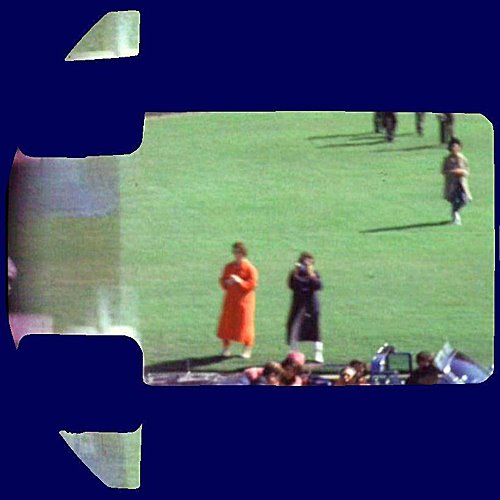
US News & World Report has a couple of short pieces (one and two) about possible tampering involving the Zapruder film of the assassination of JFK. Links to scanned images are on the second of the two pages. Comparison of the images allegedly show discrepencies in the color of shoes, which is why I thought this might be of professional interest. Please note that I have not studied these in detail and am not supporting or refuting any allegations.

(Image Source: US News & World Report)

Cool Salt video - visual demonstration of standing waves

There is a video called Cool Salt making the rounds of the Internet science blogs (WARNING: turn the volume on your speakers or headphones down before you play the video. Some of the frequencies will hurt your ears if you don't).

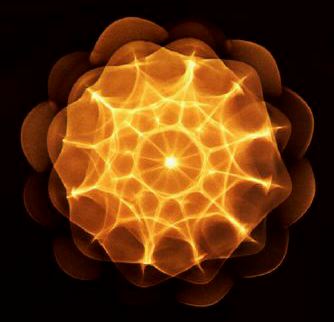
What the video shows are the standing wave patterns produced by exciting an elastic sheet with salt on it using an audio tone generator. The tone generator is then tuned through audible frequencies, pausing at obvious resonant frequencies of the sheet (i.e. frequencies where it produces standing waves determined by the dimensions of the sheet). The salt settles into patterns that help you to visualize the standing waves set up at the resonant frequencies. I read one blog comment by a competent-seeming person that said that the salt settles to the points where the sheet is not displaced at all, but that doesn't sound quite right to me. Maybe I'm missing something, but it seems to me that the salt should settle to the lowest points of the standing wave, which would be a regular pattern of sationary dips. I'll have to give this some more thought (or, even better, just do the experiment in my next lecture on audio). If any of you readers have any additional insight, please post a comment!

This type of demonstration is a classic one used in high school and university physics classes around the world. The study of these patterns can be traced back to Ernst Chladni (a modern founder of the science of acoustics) and his student Hans Jenny, who popularized the study of such patterns in his 1967 book Cymatics (from the Greek word "kyma" meaning "waves"). "Cymatics" is now the recognized term for the study of wave phenomena.

(Hat tip: Digg)
(Image Source: a Chladni figure found in the Wiki entry on Cymatics)

Monday, May 22, 2006

Former police audio engineer applies skills to Da Vinci Code voices

What our voices sound like depends on a lot of factors - vocal tract length, coarseness of vocal cords (which is in turn influenced by testosterone levels, smoking, etc.), and shape of the jaw, just to name a few. One former police audio engineer, Matsumi Suzuki, of the Japan Acoustic Lab in Tokyo has reconstructed the voices of Da Vinci and Mona Lisa for commercial purposes. The reconstructed voices are being used as part of the promotional efforts for the recent movie, The Da Vinci Code, which, in case you've been temporarily disconnected from mainstream media for the last year or more, is based on an artsy-religious-historical-thriller book by Dan Brown.
Personal aside: As I've been a Freemason for many years and am also keen on history and religion, I really am amazed at the amount of interest in 'The Da Vinci Code' and 'Angels and Demons'. I hopeful that these bits of pop-fluff entertainment will entice more people of all persuasions into studying more about our past (and judging by the number of books in the local bookshops on all aspects of 'The Code', somebody must be). It is my fervent belief that we have a lot to learn from our ancestors. They were people just like us in their struggles, hopes, and dreams but probably a good bit smarter and wiser since they actually used their senses and brains for analyzing things, both small and large.
I originally got onto this topic via this article on PhysOrg but after some digging around trying to find an actual link to the Japan Acoustic Lab webpage (which I didn't ever find) I came across a more comprehensive write-up on the origins of the Da Vinci and Mona Lisa reconstructions. It turns out that the lab was reconstructing various famous voices that are now sold as ringtones for mobile phones.

As far as forensic science goes, I was pleased to see that many of the articles I found on the Internet about the reconstructions did point out that there were a lot of assumptions that had to be made, including Mona Lisa's height for starters as she is sitting down in her portrait.

(Image source:
J@pan Inc. website)


How about downloading some legal free music?

The University of California Santa Barbara has been experiencing a rash of ripping and downloading - but unlike many universities it isn't worried because this isn't the illegal type. The Cylinder Preservation and Digitization Project at UCSB has taken 6000 cylinder recordings and made them available online as individual downloads and an internet radio stream. Because of their inspired efforts, you can listen to historical figures, such as Theodore Roosevelt and Ernest Shackleton, as well as comedy routines, church choirs, arias, the Orchestra of Afghanastan, and many more important, beautiful, and eclectic recordings made between 1875 and 1929.

It is surprisingly refreshing and addictive. Give it a listen and hear for yourself.

(Hat tip: Daily Telegraph)
(Image source: UCSB Cylinder Preservation and Digitization Project)

Monday, May 08, 2006

DIY Camera Obscura

In way of background for this post, I should explain that a camera obscura is a dark box (or room) with a hole in to that allows an image from outside to be projected into the camera (meaning, in the original sense, a "box"). The image is upside-down due to the pinhole lens effect. Also, the larger you make the hole the brighter but more fuzzy the image is. The camera obscura was the forerunner of both cinema and film cameras. Special rooms were constructed to allow paying audiences to view these projections as a form of entertainment.

With that background, I offer a link to a DIY camera obscura. This is a great project that improves on the original variety by incorporating a modern lens to allow bright AND sharp(er) images at the same time. I'm planning on making one of these with my kids during the summer holidays so they can view the morning sunrise in an interesting way.

(Hat tip: Make)

Monday, May 01, 2006

Small world image contest

Nikon has been running a contest since 1973 for images captured from microscopes. Here is a gallery of this past year's winners along with a few particularly striking ones from previous years. Technically cool and artistic as well. Enjoy!

(Image source: Nikon Small World Gallery)

Friday, April 28, 2006

Light posting coming to an end

Posting has been light these last two weeks due to work-related travel. On the plus side, I got to attend the SPIE Defense and Security Symposium in Orlando, Florida, USA. Lots of good optics kit on exhibit, along with some very good presentations on the technical side.

Saturday, April 08, 2006

Microphone array support coming with Windows Vista

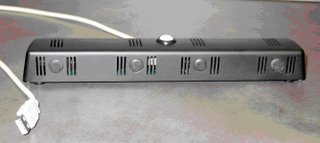
Microphone array beamforming is a subject that I have given a lot of my attention to over the last ten years or so. Simply put, microphone arrays are the electronic equivalent of a parabolic dish (those big plexiglass dishes that they use at football games to hear the sounds of contact and shouted calls on the field). Mic arrays let you hear sounds in a particular direction, possibly even far away, depending on the system design and environmental conditions.

As you might guess, I was pleased to learn last year that Microsoft will be building support for small arrays into Vista, its next generation version of Windows. The idea is that laptop and tablet PC manufacturers will embed small (4 element) mic arrays into their products to focus on the user's voice and cut down on noise so that VOIP, speech recognition, and other voice-based applications can work better. They also included an automatic echo canceller (AEC) to kill feedback loops between the microphone and loudspeaker in the laptop or tablet PC. These feedback loops are familiar to all who remember assemblies in gradeschool when the principal got his microphone too close to the loudspeaker and everyone got an earful of a high-pitched screeching tone! This would also happen on a VOIP call if the AEC wasn't included, so that is a good thing.

Anyway, I came across a introductory video clip from Microsoft Research on the topic of mic arrays and what is coming out in Vista. It can be found here. Note for Firefox users: you may need to use "Open in IE Tab" for the plug-in to play the video correctly.

(Image source: Microsoft Research - a four element, uniformly spaced, linear microphone array with USB cable)

Wednesday, April 05, 2006

Analysis of US presidential candidates using linguistics

The Washington Post reports on a study by researchers at UT-Austin (Texas, USA) that analyzed transcripts of President Bush, Vice President Cheney, Senator Kerry, and Senator Edwards on the campaign trail. The results may surprise you, especially if you are a US Democrat. Words do matter...

World's First Commercial UV Camcorder

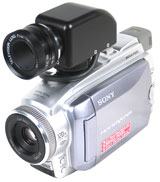
Seems strange that it apparently hasn't been done before, but Oculus Photonics has introduced the world's first UV camcorder, called the UVCorder(TM). The press release on Laboratorytalk says that it images in the 300-400nm range (near-UV band with peak at 370nm). The UV subsection of the system is actually a module that mounts on a visible light camcorder (both included as part of the system). The UV video is displayed on a 3.5 inch (8.9 cm) LCD.

Sounds pretty neat from the description, but seeing some images helps non-specialists understand why UV imaging is used in forensics. You can see some right now by going to their site and watching the Flash presention of visible and UV stills. Disappointingly, no video from the unit was posted on the site. They do list the main technical specifications, where it states that this particular Sony visible light camcorder uses Memory Stick for storing the images (still and AVI) and that it weighs 1.2 lbs (0.54 kg).

(Image source: UVCorder website)

Tuesday, April 04, 2006

Replace bifocals with liquid-crystal eye lenses

Researchers at Arizona State University (USA) have developed a thin liquid-crystal lens that can change refractive indexes (focusing powers) instantly. Assuming it makes a successful transition to the marketplace, this technology could improve the lives of millions of bifocal wearers. Links are here and here.

(Hat tip: Geek Press)

Sunday, April 02, 2006

Humans ignore the evidence of their own eyes to create a fictional stable world

Here is a writeup about research from Oxford University that was published in Current Biology on how the brain processes visual information, in particular what appears to be an assumption that it makes that works pretty well in the real world, but not in our developing computer-based virtual worlds (or "immersive reality" as it is called in the writeup).

I'll quote one portion that I particularly liked:
Commenting on the findings that people ignore the evidence of their own eyes, he cites Bayes, an eighteenth-century mathematician. ‘Bayes said that what we believe to be the state of the world is the product of two things: your prior assumptions and your sensory information. If your sensory information is very specific, you’ll go with that. But if it’s poor, or confusing, you’ll go with your prior assumption. That’s what seems to be happening here.’ In other words, the subjects’ belief that rooms stay the same size is so strong that it overrides all the usual cues from binocular disparity and motion parallax.
(Via Digg)